Enhancing the toolbox of transition forest management
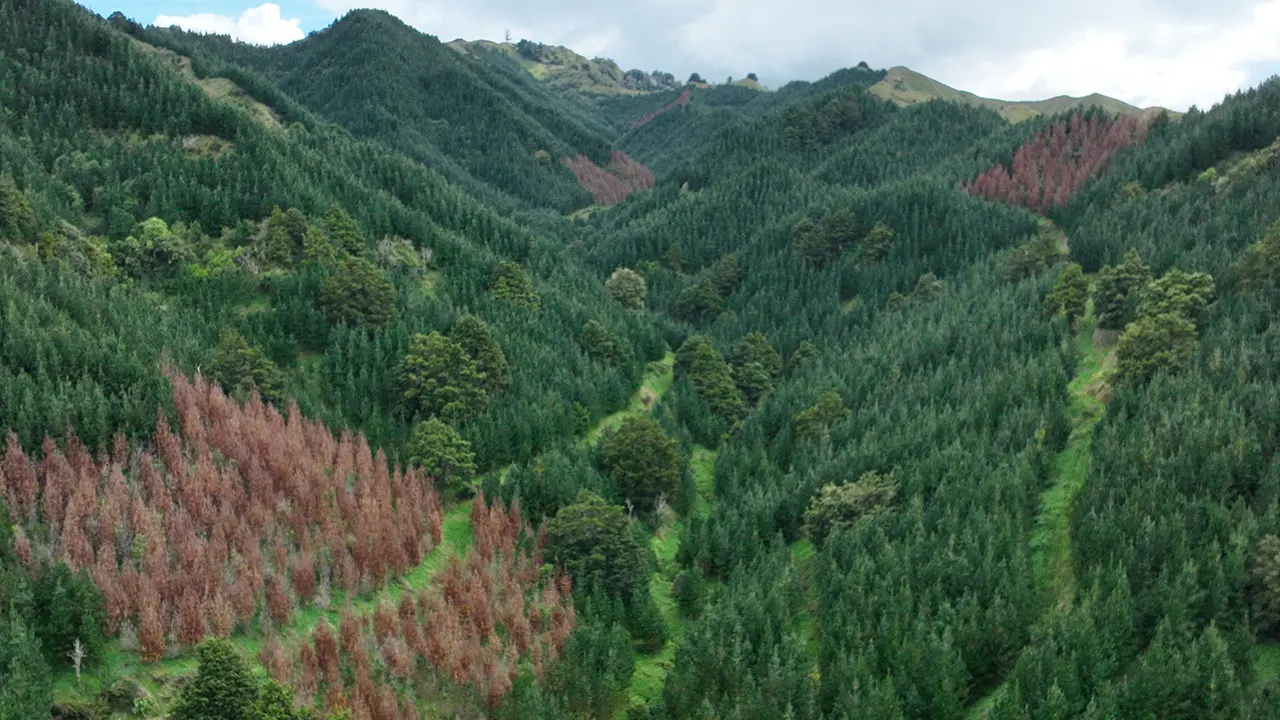
Nateva’s native tree seed island programme is now seeing notable results, after five years of fine tuning in a process of operational refinement.
As part of the comprehensive management of its conservation estate – currently extending over 68,000 hectares – the first native tree seed islands were established in 2022, in three newly-planted, permanent regeneration forests in the upper and central North Island.
Planted native areas across multiple sites are now showing a real difference in growth and development, where this key tool in Nateva’s active forest management programme is applied as part of a long-term transition regime.
Supporting native regeneration
Seed islands form a key part of Nateva’s active management programme. Seed islands are discrete patches (islands) of planted native trees, used to establish carefully selected native trees. Spread across the whole forest, the native plantings are designed to provide a source of wind-blown and bird-distributed seeds that support the regeneration of a complex and biodiverse forest.
To provide protection for the new native seedlings, Nateva manages grasses and invasive weeds while controlling pests, like browsing deer and goats, which can significantly damage the tender new plants. The surrounding exotic trees, selected as a nurse crop because they are hardier and faster growing, also provide shade and wind protection, while rapidly sequestering carbon.
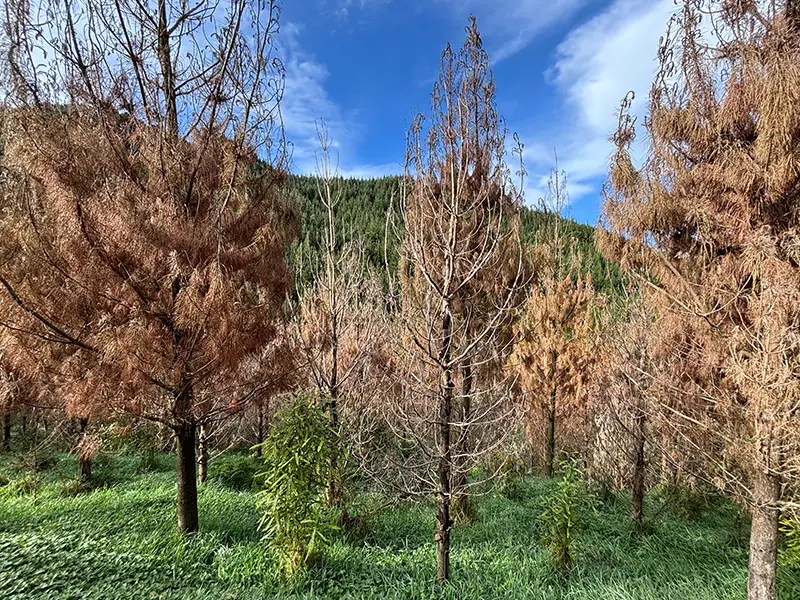
Selected pine trees are thinned and allowed to decompose in place, accelerating the natural cycle and reducing competition with the native trees.
Nateva Native Forest Advisor Matt Upton, who has worked on the programme since its inception, says while Nateva has had to adapt to ongoing challenges, particularly to prevent pest reinvasion, the team has observed good growth in the burgeoning native environment.
“The survival rate has been really good,” says Matt, “The native pioneer species we selected for their fast initial growth are now reaching three to four metres, while the late successional ones – like the totara and kahikatea – are probably getting up to around two-and-a-half metres.”
Once selected pine trees – now reaching up to around six metres – are thinned, they are allowed to slowly decompose in place. This process mimics but accelerates the forest’s natural lifecycle, allowing more light into the native stands, and transferring stored nutrients into the ground.
Restoring a native forest
After the initial native tree seed island plantings, the Nateva team has been using their observations of the earlier-planted sites to refine the programme. The programme is based in extensive scientific research of the conditions for regeneration in New Zealand, with over 50 studies conducted over the last five decades. However, Nateva is the first to operationalise native regeneration at scale through its active management programme.
“We’ve learned a great deal since we started by doing a lot of data capture, maintenance and monitoring of the sites,” says Matt.
“The whole thing’s been quite a learning experience, particularly in observing the almost constantly shifting environment and adapting to the differences at each site. It’s certainly not a one-size-fits all approach.”
As well as tailoring their approach to the topography and other localised environmental features, the team has been evolving the native tree seed island programme over a number of new sites. The native tree seed islands are carefully located to maximise the forest design and to link with key site characteristics such as soils, shelter and exposure. Guidance is also taken from Nateva’s Native Connectivity Index, which helps Nateva link the native seed islands with existing native bush remnants to optimise their impact.
Updates to the programme have included changing the size of the seed islands, with increased numbers of smaller plots enabling better monitoring and more efficient management. Nateva has also been refining the selection of species and where they are located in the detailed planting plans.
Data capture has also been key for the research-led Nateva team, with each new native seedling now getting its own unique identifier to allow on-site managers to pinpoint its location and monitor individual survival and growth rates.
“The final version is far more refined, allows for better data capture and monitoring, and should enable better survival rates because of that,” says Matt.

Signs of biodiversity development
As well as the growth and development of a diverse forest, particularly with the longer-term establishment of our native forest giants like tōtara, rimu, kahikatea and kauri, Matt is expecting to see an increase in other key biodiversity measures in the forest.
“Some of the species we had originally planted – what you’d term an early successional or pioneer species, like karamū – start fruiting early, so we’d expect to see an increase in the numbers of frugivorous bird species and even some tūī, as well as the insectivores like fantails.”
Ultimately, that growth in biodiversity will help support the overall native regeneration across the whole forest area, accelerating the process of Nateva’s plan to restore native forest across its conservation estate, while capturing planet-heating carbon from the atmosphere.